Approximately
12 miles to the northwest of Kamloops you will find Pass lake. It is easily accessible via a brief drive
along the Lac Du Bois road from the Bachelor Hills area of Kamloops.
Except in times of extreme rain fall, the road is 2 wheel drive
accessible. Pass lake is a small lake. It is ideal for either a
small boat, float tube or kick boat. Motors are definitely not necessary.
It drops off relatively quickly to depths of 35 feet or more. There
are some shoal areas. You will find the best ones at the west end
near the farm house and along the north shore about half way along
the lake.
Pass lake is noted for its' population of large trout. Be advised
however they do not come easy. Fish do not reach large sizes by
being stupid! This was no exception the first time I visited this
little gem. As we readied ourselves for the days fishing we noticed
mating flights of Callibaetis spinners, damsels and dragons were
also crawling out of the water to emerge. Conditions were ideal.
So I thought. It was not to be the case. I had begun the day fishing
with a damsel fly nymph. It seemed like a logical choice given the
emerging nymphs I had seen. A damsel nymph has been a good exploratory
pattern for me on new waters as the nymphs are quite active in their
habits. My Aftershaft Damsel had been very good to me over the years
and today I expected no different. Today was to be different and
after 2 hours I had not had a touch on my damsel nymph, my Callibaetis
patterns or even my dragon patterns for that matter. I was beginning
to get that skunked feeling.
Just when things seemed to be their darkest I noticed a local angler
row out from shore and position himself in what I new to be deep
water. The depth he anchored in was over 20 feet deep. Curious,
I kept my eye on him as I carried on probing the shallower areas
of the lake. Within about 20 minutes he had a fish on. This was
soon followed by a couple of others. I quickly figured that moving
into deeper water might be an advisable strategy. I positioned myself
a courteous distance away and began to change to my type 3 Uniform
Sink line. While I was preparing my tackle I noticed a number of
chironomid shucks on the waters' surface. I decided to tie on a
#12 black chironomid pattern and cast out my wet line. A black chironomid
is always a great starting point and many times it is the only color
you will need. The length of line I cast was equivalent to the depth
of water I was fishing, 24 feet. I allowed the line to sink and
began a very slow hand twist retrieve. My attention was not completely
focused when the fish struck half way through the retrieve. I can
still recall the ferocity of the strike. I was fortunate that my
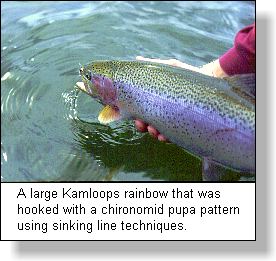
rod was able to absorb the smash take. Over 15 minutes later I managed
to land a beautiful silver 4 pound Kamloops rainbow. My arms were
sore but I was grinning ear to ear with the satisfaction of my first
Pass lake fish. A careful use of my stomach pump revealed heavy
feeding on #12 and #14 black and grey chironomids. I carefully revived
the fish and admired its' beauty as it slipped back into the depths.
This was not the first time sinking line chironomid
techniques have saved the day for me. I continue to use sinking
line techniques today. It is my preferred method in water over 20
feet deep. Yet from what I have observed it is method that does
not seem to get the credit it deserves. For the novice angler who
is having trouble detecting strikes using floating line techniques
sinking lines are a great confidence builder. The takes are often
aggressive. Keep in mind that chironomids are not just creatures
of the shallows but are capable at living at depths of over 40 feet
or more.
As far as equipment goes you need a medium to soft action rod to
absorb the firm strikes. A full sinking fly line of either a type
3 or 4 density is preferred. Naturally lesser densities will work
but they will just take longer to sink. As for leader length I seldom
exceed 6 feet. Bungee type leaders are now available with a shock
absorbing butt material that will help deal with the strong takes
associated with this method. Your selection of chironomid patterns
is no different than for other methods of chironomid fishing. Although
as my friends will confirm I do have a preference for bead head
patterns.
The next key is to firmly anchor your boat,
float tube or kick boat. If you are using a boat this means anchoring
from both the stern and bow of the boat. If you are using a kick
boat or float tube a single anchor will do. Maximum control of your
retrieve is vital to success when fly fishing stillwaters. This
is especially true when fishing chironomid patterns. Make sure you
mark your anchor rope at regular intervals such as five feet. Accurately
knowing the depth of water you are in is critical. With a marked
anchor rope you simply multiply the number of intervals by the distance
they are apart. For example 5 intervals, 5 feet apart equals a depth
of 25 feet.
Now that you have firmly anchored yourself and know the depth of
water you are fishing you can prepare for your presentation. Simply
strip off an amount of fly line equal to the depth of the water
you are anchored in. Usually one pull equals roughly 2 feet. Once
your line length is determined make your cast and allow the line
to sink until it is hanging directly below you. Confident the fly
has reached the bottom you can now begin your retrieve. A very,
very slow hand twist retrieve is typically best. The hand twist
is a busy retrieve that keeps your hands occupied without retrieving
your pattern too fast. Depending upon the depth a retrieve of over
2 minutes or more is not unheard of. It is OK to mix in the odd
quick strip to draw attention to your pattern but don't overdue
it.
Be prepared for savage takes when using this
method. Your takes will typically be near the water's surface. You
might be tempted to switch to a dry line thinking the fish are cruising
near the surface. Resist this temptation. The trout will follow
your pattern up to the surface carefully inspecting it. It is believed
that once near the surface the trout has to decide whether or not
to take the offering. If the trout takes the pattern it will come
over the top and take the pattern as it swims back down. This registers
as a very firm and aggressive strike. The force feels like the rod
will be ripped from your hands and if your rod is to stiff or you
are heavy handed you will experience break offs. Your fish will
typically be hooked firmly in the upper jaw.
Sinking line techniques have worked incredibly well for me over
the years. With this method I have been successful on numerous lakes
in B.C. and Western Washington. I have used this method in water
over 30 feet deep if chironomids are coming off. The next time you
see swallows, Bonaparte gulls or Night Hawks actively working over
deep water. Row over and investigate. If chironomids are coming
off put on a wet line and get that sinking feeling. And remember
to hang on tight.
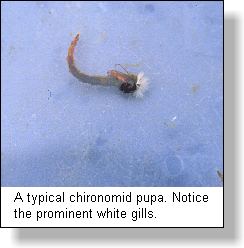
2 of my favorite chironomid pupa patterns:
Bead
Head Pupa
Thread: Color to Suit
Hook: Tiemco 2457 #8-#16
Rib: Fine Copper, Silver or Gold wire
Body: Frostbite, Flashabou, or Crystal Hair
depending upon your color preference
Thorax: Peacock Herl
Head: Gold, Copper or Black Bead
Gills: White Sparkle Yarn
Emerald
Red Butt
Thread: Olive 8/0 Uni Thread
Hook: Tiemco 3761 #8-#14
Over Body: Olive V-Rib
Butt: Bright Red Flashabou
Under Body: Emerald Green Crystal Hair
Wing Case: Pheasant Rump
Thorax: Peacock Herl
Gills: White Sparkle Yarn





 This was not the first time sinking line chironomid
techniques have saved the day for me. I continue to use sinking
line techniques today. It is my preferred method in water over 20
feet deep. Yet from what I have observed it is method that does
not seem to get the credit it deserves. For the novice angler who
is having trouble detecting strikes using floating line techniques
sinking lines are a great confidence builder. The takes are often
aggressive. Keep in mind that chironomids are not just creatures
of the shallows but are capable at living at depths of over 40 feet
or more.
This was not the first time sinking line chironomid
techniques have saved the day for me. I continue to use sinking
line techniques today. It is my preferred method in water over 20
feet deep. Yet from what I have observed it is method that does
not seem to get the credit it deserves. For the novice angler who
is having trouble detecting strikes using floating line techniques
sinking lines are a great confidence builder. The takes are often
aggressive. Keep in mind that chironomids are not just creatures
of the shallows but are capable at living at depths of over 40 feet
or more.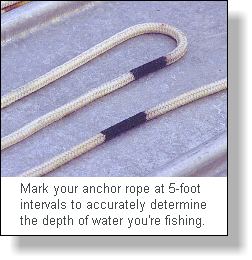 The next key is to firmly anchor your boat,
float tube or kick boat. If you are using a boat this means anchoring
from both the stern and bow of the boat. If you are using a kick
boat or float tube a single anchor will do. Maximum control of your
retrieve is vital to success when fly fishing stillwaters. This
is especially true when fishing chironomid patterns. Make sure you
mark your anchor rope at regular intervals such as five feet. Accurately
knowing the depth of water you are in is critical. With a marked
anchor rope you simply multiply the number of intervals by the distance
they are apart. For example 5 intervals, 5 feet apart equals a depth
of 25 feet.
The next key is to firmly anchor your boat,
float tube or kick boat. If you are using a boat this means anchoring
from both the stern and bow of the boat. If you are using a kick
boat or float tube a single anchor will do. Maximum control of your
retrieve is vital to success when fly fishing stillwaters. This
is especially true when fishing chironomid patterns. Make sure you
mark your anchor rope at regular intervals such as five feet. Accurately
knowing the depth of water you are in is critical. With a marked
anchor rope you simply multiply the number of intervals by the distance
they are apart. For example 5 intervals, 5 feet apart equals a depth
of 25 feet.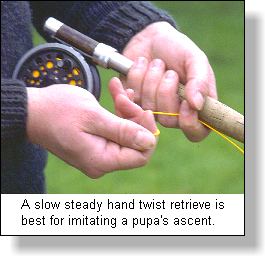 Be prepared for savage takes when using this
method. Your takes will typically be near the water's surface. You
might be tempted to switch to a dry line thinking the fish are cruising
near the surface. Resist this temptation. The trout will follow
your pattern up to the surface carefully inspecting it. It is believed
that once near the surface the trout has to decide whether or not
to take the offering. If the trout takes the pattern it will come
over the top and take the pattern as it swims back down. This registers
as a very firm and aggressive strike. The force feels like the rod
will be ripped from your hands and if your rod is to stiff or you
are heavy handed you will experience break offs. Your fish will
typically be hooked firmly in the upper jaw.
Be prepared for savage takes when using this
method. Your takes will typically be near the water's surface. You
might be tempted to switch to a dry line thinking the fish are cruising
near the surface. Resist this temptation. The trout will follow
your pattern up to the surface carefully inspecting it. It is believed
that once near the surface the trout has to decide whether or not
to take the offering. If the trout takes the pattern it will come
over the top and take the pattern as it swims back down. This registers
as a very firm and aggressive strike. The force feels like the rod
will be ripped from your hands and if your rod is to stiff or you
are heavy handed you will experience break offs. Your fish will
typically be hooked firmly in the upper jaw.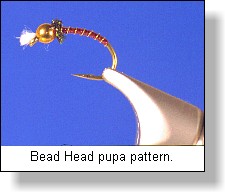 Bead
Head Pupa
Bead
Head Pupa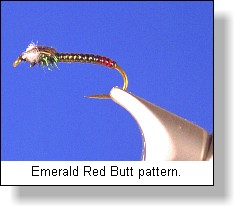 Emerald
Red Butt
Emerald
Red Butt
