
Steelhead fishing series
"April Rivers"
with Barry M. Thornton
 The bright steelhead fly swirled with the current then disappeared
as it was swallowed by the frothing white water at the head of the pool.
This was the second time this afternoon that I had fished this, one
of my favoured April pools. My first casts, about two hours previously,
had discovered a silver fish resting in these protective waters. On
one retrieve during that earlier time, I had felt the nip of the fish
but it ended in a silver flash, an on-off steelhead. I have learned
from experience that if a pool is rested after an on-off fish, I recommend
at least 30 minutes, that the same fish will take your fly a second
time it drifts through. Now, during my second try, I cast the fly in
the same waters as before and waited for the line halt as I dead-drifted
the fly through the steelhead holt. It was a sudden strike when it came,
a solid take with the belly of the sink tip fly line setting the hook.
The strike triggered a flashy reaction from the steelhead, a surface
dance and leap, then a long 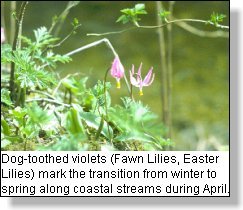 run
to the tailout of the pool. Our struggle lasted a good ten minutes and
then the fish lay over on it's side as I brought it in to the shallow
beach waters for a quick release. As I watched the chrome coloured hen
steelhead swim back into the depth of the pool I found myself strangely
satiated. run
to the tailout of the pool. Our struggle lasted a good ten minutes and
then the fish lay over on it's side as I brought it in to the shallow
beach waters for a quick release. As I watched the chrome coloured hen
steelhead swim back into the depth of the pool I found myself strangely
satiated.
In the distance Alder brake, the soft whump-whump-whump-whumppppp of
a ruffed grouse floated over the singing chuckle of the river. On the
beach beside me were the dainty 'V' pointed footprints of a blacktail
deer, prominent in the clean receding beach sand and patterned almost
reminiscent of a Japanese sand garden. Daily I had watched the river's
canopy change, small buds opening to leaves and, the wind sighs now
rather than howls as it drifts through the dressing tree boughs. Over
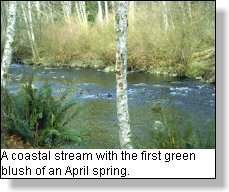
the past week I have observed the river water take on a new and exciting
deep green, the steelheader's colour, and slowly begin to be clouded
with mountainous snow melt. This is my April, my favoured month for
winter-run steelhead fly fishing!
 Of
all the months when winter-run steelhead are migrating up native streams
to spawn in headwater nurseries, none are more appealing to me than
the month of April. It is in April that the west coast is shaking off
the last bite of winter. January ice, February cold, and March snow
and rain, are now a thing of the past. Of
all the months when winter-run steelhead are migrating up native streams
to spawn in headwater nurseries, none are more appealing to me than
the month of April. It is in April that the west coast is shaking off
the last bite of winter. January ice, February cold, and March snow
and rain, are now a thing of the past.
I have found in April that the warm spring rains veil river colors
and give ascending steelhead confidence to travel in shallow waters.
It is here in these same shallows that I am at last able to fish my
barbless flies effectively. Fortunately, these same rain-warmed waters
affect steelhead in such a way that they will readily strike at these
flies as they drift through prime holding waters. It is in April that
rising temperatures in the stream waters give steelhead, who are poikilothermous
or cold blooded, added energy in their battles with my line and reel.
And, it is in April that run-off rivers are full of returning steelhead
homing to reach that very special pool where they will spawn.
April is the month to steelhead on run-off rivers, not those rivers
with a lake as their major headwater source. In coastal run-off rivers,
steelhead have evolved to meet the specific river temperatures that
occur with melting high mountain snows. Rather than enter the river
in the cold winter months they enter with the warming April spring melt.
 April,
like October, is a profusion of color. But, unlike October when life
appears ready to hide in order to escape the coming onslaught of winter,
April is the month of spring, the month of hope, of energy, and, of
pending life. Sprouting life in April is soft, delicate, satiny and
tender. Colors are a pastel palette of the full spectrum of green, the
favoured color of the active steelheader. April,
like October, is a profusion of color. But, unlike October when life
appears ready to hide in order to escape the coming onslaught of winter,
April is the month of spring, the month of hope, of energy, and, of
pending life. Sprouting life in April is soft, delicate, satiny and
tender. Colors are a pastel palette of the full spectrum of green, the
favoured color of the active steelheader.
It is with the profusion of April wild flowers that Nature provides
a very special ingredient for the river angler, the angler naturalist.
Walking along river trails, the wild
flower the angler first finds are the sadly misaligned Skunk Cabbage.
It adds a depth of yellow in a tall coveted stalk. Usually found near
tributary marsh areas, beaver ponds or elk meadows, Skunk Cabbage blooms
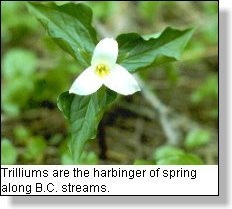
are the true first wild flowers of a Pacific coastal spring. The three
sided Trilliums, with striking white flowers, is a close second. At
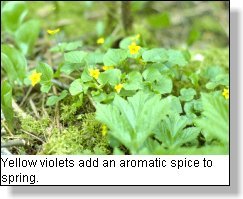
about the same time that the Trillium flourishes, a diminutive yet arresting
yellow flower, no larger than a finger nail, blooms, hidden in the duff
accumulation of autumn's fallen leaves. This pansy faced flower, the
Yellow Violet, grows in small secretive clumps and is a treasure to
behold.
 As
April advances and warm spring weather becomes the norm, Bleeding Hearts
with their cupped pink arms and celery leaved stalks fill the forest
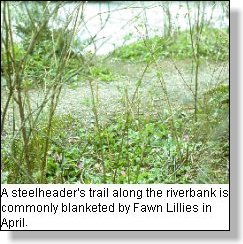
floor under hemlock, spruce and fir. It is also at this time that the
striking head-bowed pink Fawn Lilly (Dog-toothed Violet) struggles upwards,
then bend on their Shepherd's-hook stalks to open six pink blossom petals
and expose a delicate white stem coated with yellow pollen. Finally,
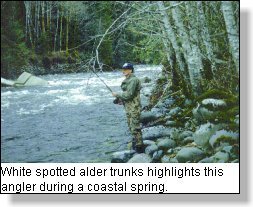
along most river trails, the pink blossom blush of the wild red current
shrub is strikingly marked against the speckled white trunks of alder
trees. As
April advances and warm spring weather becomes the norm, Bleeding Hearts
with their cupped pink arms and celery leaved stalks fill the forest
floor under hemlock, spruce and fir. It is also at this time that the
striking head-bowed pink Fawn Lilly (Dog-toothed Violet) struggles upwards,
then bend on their Shepherd's-hook stalks to open six pink blossom petals
and expose a delicate white stem coated with yellow pollen. Finally,
along most river trails, the pink blossom blush of the wild red current
shrub is strikingly marked against the speckled white trunks of alder
trees.
April also marks the spring migration and return of many wild birds.
Hammering northern flickers, chattering chickadees, whistling finches,
honking geese
and screaming eagles all add to the ambience of nature's west coast
streams. Stepping back from the rushing river sounds, these feathered
dinosaurs can be heard adding a never ending song filled with excitement
and the hope of a fresh new year.
 Small
animals also appear in more numbers in April. Chattering squirrels,
frolicking river otters, low swimming industrious beavers and sleek
muskrats and mink,
all add their presence to the April experience. Larger mammals like
blacktail deer and Roosevelt elk have begun their annual spring vertical
migration, a lengthy journey up to high mountain summer pastures following
the valley bottoms of the rivers to their webbing watersheds. Small
animals also appear in more numbers in April. Chattering squirrels,
frolicking river otters, low swimming industrious beavers and sleek
muskrats and mink,
all add their presence to the April experience. Larger mammals like
blacktail deer and Roosevelt elk have begun their annual spring vertical
migration, a lengthy journey up to high mountain summer pastures following
the valley bottoms of the rivers to their webbing watersheds.
Wild flowers and wildlife are the harbinger of spring, the season for
the fly fisher to angle in run-off rivers! For the observant contemplative
angler-naturalist, it has been my experience that April offers so much
more than fish!
"The End"
© Copyright Barry M. Thornton
Barry M. Thornton
|