Birds in the West
"Black Brant - The Poetry of Song"
with Barry M. Thornton
 Spring is a time of marvel in British Columbia. On the Pacific coast
Spring arrives early, and unlike the vast majority of Canada, we have
months rather than weeks of growth and refreshment. Spring also offers
many wildlife wonders. It is early in spring, during late March, that
the first swallows return, darting, swooping and exploring, as they
search for that special nesting locations. In the shallow coastal areas
most herring have spawned by the time April arrives, yet, many seals,
sea-lions and sea birds still linger hoping for a new or late silver
bounty upon which they can feed.
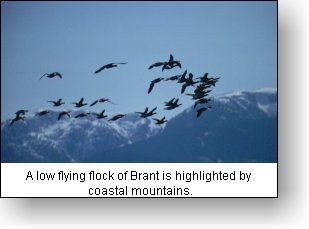 A
British Columbia coastal Spring also offers the view of an unique migrating
sea goose. This is the brant, a common sea bird on both the east
and the west coast of Vancouver
Island. In that vast inland sea, the Strait
of Georgia, it is a northern migrant in the Spring visible only
during April and May, then it flies to the high Arctic where it nests.
What is unique about this small sea goose is the fact that while it
migrates north through the Strait of Georgia and along the east coast
of Vancouver Island, it migrates south in the open Pacific down the
west side of Vancouver Island during the Fall, completely bypassing
the vast waters of the Strait of Georgia. Their southern migration appears
to be a single flight starting from marshaling areas in Alaska and ending
in Mexico. A
British Columbia coastal Spring also offers the view of an unique migrating
sea goose. This is the brant, a common sea bird on both the east
and the west coast of Vancouver
Island. In that vast inland sea, the Strait
of Georgia, it is a northern migrant in the Spring visible only
during April and May, then it flies to the high Arctic where it nests.
What is unique about this small sea goose is the fact that while it
migrates north through the Strait of Georgia and along the east coast
of Vancouver Island, it migrates south in the open Pacific down the
west side of Vancouver Island during the Fall, completely bypassing
the vast waters of the Strait of Georgia. Their southern migration appears
to be a single flight starting from marshaling areas in Alaska and ending
in Mexico.
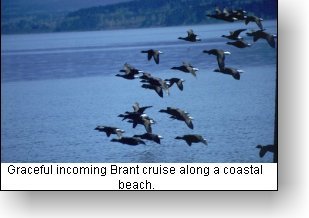
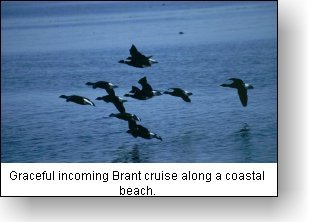
 Early
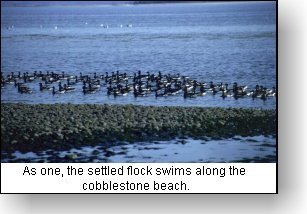
in April I watched the first small flocks arrive during those days when
the tide was particularly low. Swinging in to the beach from the open
saltwater, they would stoop into sandy bays where clusters of green
sea lettuce had washed up on shore or which clung to pockets of cobblestone
rocks. Their flight, on a warm bright Spring morning was true poetry
in motion. Brant like eel grass and this is one of the primary attractions
which draws them to numerous areas of the east coast of the Island in
the spring. Early
in April I watched the first small flocks arrive during those days when
the tide was particularly low. Swinging in to the beach from the open
saltwater, they would stoop into sandy bays where clusters of green
sea lettuce had washed up on shore or which clung to pockets of cobblestone
rocks. Their flight, on a warm bright Spring morning was true poetry
in motion. Brant like eel grass and this is one of the primary attractions
which draws them to numerous areas of the east coast of the Island in
the spring.
Historically brant first appeared on their migration north late in
February, in fact large numbers were known to actually winter in the
Strait of Georgia, like many of the dabbler (butts-up) ducks. Unfortunately
changes in habitat and shoreline development have eliminated the specific
areas, often near estuaries, where they held. But, like the Canada goose,
they too are making a rapid rise to near historic numbers. Returning
Brant have captured the interest of many communities
along the east coast of Vancouver Island. One region, Parksville
and Qualicum,
has seen a dramatic increase in Brant during the past few years. These
are coastal communities with vast sandy beaches, the ideal intertidal
stopping areas for Brant. The interest in the area has been so strong
that the community now holds an annual "Brant Festival" during the first
weeks of April. This festival has become a noted location for birders,
photographers, wildlife carvers, and painters.
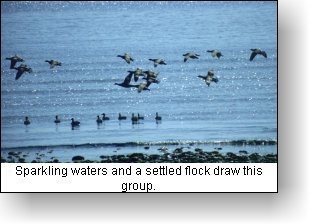
 I
am writing much of this with my new laptop on a lonely coastal beach,
a new tool for this wandering writer. In front of me a flock of about
thirty brant are 'chortling' and 'honking' with their numerous flock
calls - a never ending sound! What is most striking at this moment is
the white flash of their posterior end and tail when they butt-up to
reach for eel grasses and seaweeds. The distinct division, almost a
painted line between the white and black feathers, reminds me of similar
distinct white and black lines on Killer
whales. When I look at native art styles I often wonder if this
is one of the animal features that lead to their distinct style of white
and black lines. I
am writing much of this with my new laptop on a lonely coastal beach,
a new tool for this wandering writer. In front of me a flock of about
thirty brant are 'chortling' and 'honking' with their numerous flock
calls - a never ending sound! What is most striking at this moment is
the white flash of their posterior end and tail when they butt-up to
reach for eel grasses and seaweeds. The distinct division, almost a
painted line between the white and black feathers, reminds me of similar
distinct white and black lines on Killer
whales. When I look at native art styles I often wonder if this
is one of the animal features that lead to their distinct style of white
and black lines.
The Brant Branta bernicla nigricans ( Pacific brant, sea-goose, black
brant) is a small goose, about the size of the common mallard.
From a distance the Brant takes on a sooty black color except for the
stark white rear. It has a long wing in relation 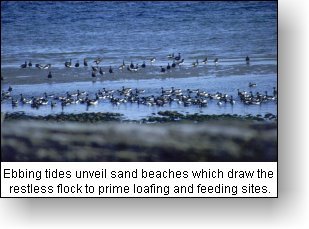 to
it's body length making this an identifying feature which distinguish
the black brant from other waterfowl. The black brant also has white
feathers ringing the full neck, similar to the Canada
goose, another very obvious key identifying feature. to
it's body length making this an identifying feature which distinguish
the black brant from other waterfowl. The black brant also has white
feathers ringing the full neck, similar to the Canada
goose, another very obvious key identifying feature.
The coast of British Columbia offers a vast cornucopia of birds. In
the Spring they are in their full adult plumage and give the photographer
many opportunities to take pictures during the lengthy coastal spring
period. Special species like the Brant are readily available in highly
accessible regions for those interested in expanding their birding knowledge.
"The End"
© Copyright Barry M. Thornton
Barry M. Thornton
|