
Understanding
the Structure of a Lake
with
Brian Chan
British Columbia
is blessed with an abundance of lakes
found throughout all areas of the province. In particular, the central
and southern interior regions
of B.C. are well endowed with small highly productive lakes that offer
tremendous trout fishing opportunities matched by very few other places
in the world. Learning how to successfully fly fish these rich natural
resources will add to your outdoor experience.
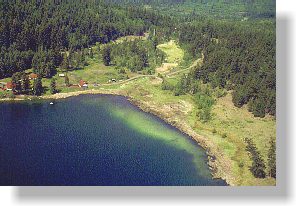
The first
lesson to learn is understanding where trout live in a lake. It is often
said that trout are a lot easier to locate in rivers and streams because
of the easily distinguished habitat structure of pools, riffles, runs
and flats. Lakes on the other hand, do not show their internal structure
as easily and trout are not under the influence of current, which in moving
waters dictate where they can live. A typical small lake is shaped like
a shallow soup bowl. Shallow water extends out from the shoreline and
gradually gets deeper until reaching the deep section or "bowl"
of the lake. The transition zone between shallow and very deep water is
called the "drop-off." Each part of the lake plays an important
role in the overall ecology of the water
body.

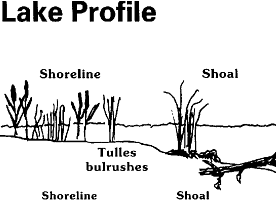 The
shallow water/shoreline area where water is less than 0.5 metres deep
is very productive aquatic invertebrate (bug) and juvenile trout habitat.
This very shallow zone is often overgrown with aquatic vegetation which
provides the habitat for fish and fish food. Larger trout do not often
venture into this very shallow water as they are very vulnerable to predators
and for most of the summer months this water is too warm to stay in for
any length of time. As this shallow zone deepens to approximately the
six to 8 metre depth it is referred to as the shoal or littoral zone.
Sunlight or photosynthesis can penetrate to the lake bottom at these depths.
The actual amount of shoal area in a lake is determined by the clarity
of the water. Clearer water means deeper sunlight penetration. Light penetrating
to the lake bottom allows green plants to grow which in turn provides
habitat for both trout and their food sources (insects). Common aquatic
plants found growing on the shoals of interior lakes include chara, milfoil,
potamogeton, longstem bulrush, cattails and lily pads. Therefore, it is
safe to say that the majority of trout feeding activity occurs on the
shoal or at the edge of the shoal (the drop-off). The
shallow water/shoreline area where water is less than 0.5 metres deep
is very productive aquatic invertebrate (bug) and juvenile trout habitat.
This very shallow zone is often overgrown with aquatic vegetation which
provides the habitat for fish and fish food. Larger trout do not often
venture into this very shallow water as they are very vulnerable to predators
and for most of the summer months this water is too warm to stay in for
any length of time. As this shallow zone deepens to approximately the
six to 8 metre depth it is referred to as the shoal or littoral zone.
Sunlight or photosynthesis can penetrate to the lake bottom at these depths.
The actual amount of shoal area in a lake is determined by the clarity
of the water. Clearer water means deeper sunlight penetration. Light penetrating
to the lake bottom allows green plants to grow which in turn provides
habitat for both trout and their food sources (insects). Common aquatic
plants found growing on the shoals of interior lakes include chara, milfoil,
potamogeton, longstem bulrush, cattails and lily pads. Therefore, it is
safe to say that the majority of trout feeding activity occurs on the
shoal or at the edge of the shoal (the drop-off).
 In
clear water lakes the drop-off is easily identified as that zone where
you can no longer see the bottom. This transition zone offers good fish
and fish food habit as photosynthesis is still occurring and it also provides
deeper, cooler water for trout to escape to during the hot summer months
when the shallower shoal zone becomes too warm during the daylight hours. In
clear water lakes the drop-off is easily identified as that zone where
you can no longer see the bottom. This transition zone offers good fish
and fish food habit as photosynthesis is still occurring and it also provides
deeper, cooler water for trout to escape to during the hot summer months
when the shallower shoal zone becomes too warm during the daylight hours.
The deep
water zone refers to that portion of the lake that is generally greater
than 8 metres deep. Most small interior lakes are less than 25 metres
deep although some of the most productive and best known fishing lakes
have maximum depths of less than 10 metres. The deep water zone is an
important feeding area for trout during spring chironomid hatches and
late fall Water Boatman and Backswimmer mating the swarming flights. During
the warm summer months, in many lakes, the deep water zone is poorly oxygenated
and not good fish habitat.

As mentioned
earlier, the best insect/invertebrate habitat is found in the shallow
water zone through the shoal to the edge of the drop-off. Let's have a
closer look at what types of food sources live in these habitat zones.
The staple diet of trout in productive interior lakes is freshwater shrimp.
These small members of the crustacean family require calcium rich water
to maintain their chitinous exoskeleton. Shrimp live among the lush vegetation
found in the shallow water/shoal zones of the lake. Trout can feed on
shrimp at any time of the year.
Chironomids
or midges are the first big insect hatch of the year. Chironomid larvae
live in the mud at the bottom of the lake in very shallow to very deep
water. The most abundant hatches occur in water less than 10 metres deep.
The chironomid hatch is the most prolong emergence of the year. Trout
love to feed on the pupa as they rise to the surface to emerge into the
adult. Chironomid pupa range in size from two to 25 mm in length. Common
pupal colours include black, green, brown and maroon.
 Mayfly
nymphs seek cover in the submergent and emergent vegetation found on the
shoal of the lake. When fully developed the nymphs swim to the surface
of the lake to hatch into mayfly dun. Trout feed intensely on the nymphs
as they swim to the surface of the lake and on the newly emerged duns.
Mayfly nymphs adapt their colour to that of the habitat they are living
in. Mayfly
nymphs seek cover in the submergent and emergent vegetation found on the
shoal of the lake. When fully developed the nymphs swim to the surface
of the lake to hatch into mayfly dun. Trout feed intensely on the nymphs
as they swim to the surface of the lake and on the newly emerged duns.
Mayfly nymphs adapt their colour to that of the habitat they are living
in.
Damselfly
and dragonfly nymphs prowl the bottom of the shoal and drop-off in search
of a meal of shrimp or mayfly nymphs. Both of the nymphs are long-lived
and available as trout food throughout the year. Mature damselfly nymphs
swim off the bottom to within a metre of the surface and then swim horizontally
toward a cattail or bulrush patch to emerge as the adult. Trout as well
as observant anglers will see this migration. Mature dragonfly nymphs
crawl along the lake bottom to shore to emerge as adults.
Caddisflies
are identified as being present by the intricate larval cases or houses
built out of bits of vegetation or particles of sand. Larvae graze on
vegetation and detritus found on the bottom of the shallow water/shoal
zone. The pupal transformation occurs within the larval case. When fully
developed the pupa cuts its way out of the old larval case and quickly
swims to the surface of the lake. The adult caddisfly emerges and scampers
across the water in an attempt to get airborne. This provides some of
the most exciting dry fly fishing of the year.
Water Boatman
and Backswimmers are air breathing insects that form swarming or mating
flights in the late fall. Large numbers of these insects will dive into
the lake to deposit eggs. Trout will feed on these insects in all depths
of the lake. Watch for these sudden "rain showers" on bright
cloudless days in late September and early October.
Understanding
lake structure and the biology within the water are both fascinating and
important to becoming a successful lake fly fisher.
Brian Chan
riseform@shaw.ca
Brian's
Articles...
|