
History
of the Fraser River Canyon & Thompson River Canyon
Simon
Fraser, Gold Rush & Cariboo Wagon Road
|
History of the Fraser River & Thompson River Canyons |
|||||
Long before man settled this region known as British Columbia, some time between the dinosaurs and their disappearance, it's believed that the Fraser River started taking shape. Aeons passed, and very slowly the Rocky Mountains took shape, altering the flow of rivers and streams. It appears that part of the Fraser River, north of the Chilcotin drained east, into the Inland Sea, while south of the Chilcotin, it drained south and west to the Pacific. During the Tertiary period, these two rivers formed what is now the Fraser River and the canyon. Just as the Fraser River made its way through the outer Coast Mountains, the Thompson has managed to make its way through the inner mountains. The gorge the Thompson has made is stark, mountains are barren and colourful, sagebrush is everywhere and the sun beats down sucking up what little moisture there is in this area.
This part of British Columbia is steeped in history. Hundreds of years before any European saw or explored this land, the aboriginals lived here. They traveled up and down the rivers and trails trading with other tribes. Where the river was unpassable, they had paths that connected, thus making travel from the interior to the coast possible. The first Europeans to see this region, were Simon Fraser and his party. In the year 1805, Fraser and his men made their way west, but it wasn't until 1808 that they started their expedition down the river. With the help of the aboriginals who lived along the Fraser, they were able to make their way down to the Pacific Ocean and back. Sometime in 1856 or '57, near Fort Kamloops, James Huston discovered gold. The search for gold soon spread from the Thompson River to the Fraser River, and in March of 1858, the first big gold discovery was made at Hill's bar, just south of Yale. By the year 1859, prospectors had made their way up to the Quesnel River area, and in 1861 gold was found on Williams Creek, in the Cariboo. The gold rush was on. Following the miners, were merchants and businessmen with their families who built the communities and towns that brought civilization to British Columbia. The main mode of transportation from the mouth of the Fraser River to Yale, were the paddlewheelers. From Yale miners walked and used mules to get to the Cariboo goldfields in B.C.'s interior.
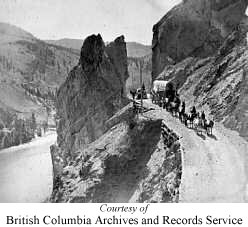
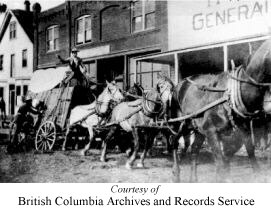
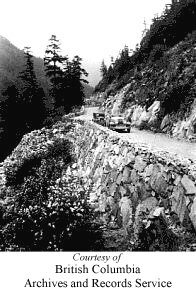
In the winter of 1861-1862 the Royal Engineers started working on the road that would become "the wagon road." This road to the Cariboo was 619 km (385 mi.) long and 54 m (18 ft.) wide. When the road was opened, the mule trains were replaced by horses and oxen. The era of the freight wagons and stage coaches was in full swing. In order to make Canada a country from sea to sea, John A. Macdonald promised to build a railroad from the east coast to the west coast. On July 20th 1871, British Columbia became a province of Canada. The Canadian Pacific Railway (CPR) route in B.C. was built through the Rocky Mountains, over the interior plateau, along the Thompson and Fraser Rivers and finally to Vancouver and the coast. |
|||||
|
BC Adventure Network members serving this area: If you would like to have your business listed, please Click Here. |
© 1996- INTERACTIVE BROADCASTING CORPORATION
History of the Fraser River Canyon & Thompson River Canyon. Simon Fraser, Gold Rush & Cariboo Wagon Road